Creating Consumer Medicine Information Resources
Contributor Toolkit
This toolkit supports the development of clear, culturally responsive medicine information resources for Aboriginal and Torres Strait Islander communities1.
It draws on person-centred care, consumer involvement and the Sharing Decision Making Model created by Mob, for Mob2,3,4.
At-a-glance
This toolkit is for NACCHO, ACCHOs, health professionals such as pharmacists, and representative bodies such as the Pharmaceutical Society of Australia.
Use this toolkit when developing medicine information resources for Aboriginal and Torres Strait Islander people and communities.
The toolkit sets out a six-step roadmap. Each step includes practical information, resources, and tools to help plan, develop and review medicine information resources.
Locally tailored resources can improve access, build trust and support informed use of medicines in Aboriginal and Torres Strait Islander communities1.
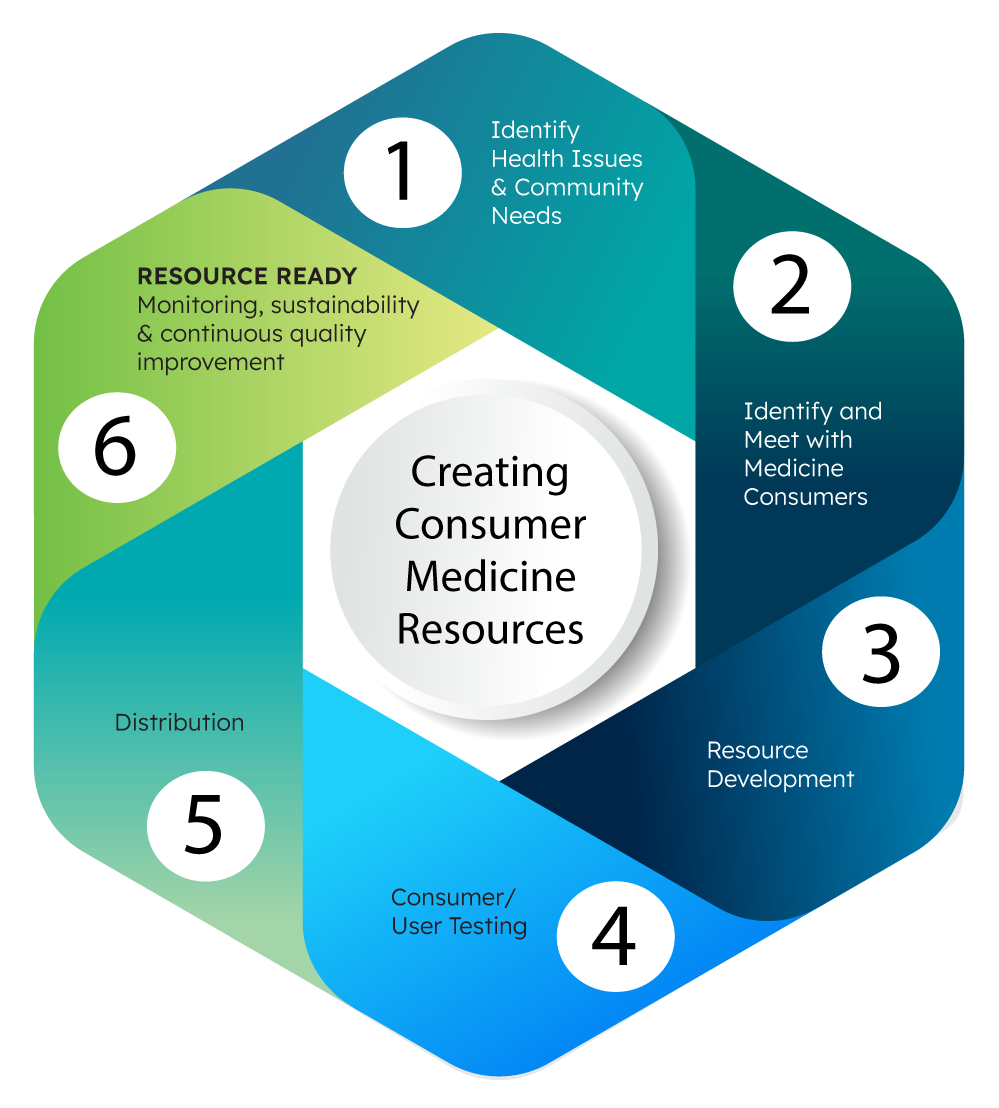
Click the picture to enlarge
Core activities involved with each step and its timeline
The steps and timeframes will vary depending on the resource, the community context, and the development team’s capabilities. The information below summarises the core activities in each step and the indicative timing.
Developer:
- NACCHO (or)
- ACCHO/s (or)
- Health Professionals
Requester: Pharma/Government
Requester: ACCHOs
Step 1
Use a top-down needs assessment form (Appendix 1) to:
- Discuss the scope of work.
- Compliance requirements.
Approx, time required: 1 month
Step 2
- Consumers’ consultations (at least 2 or 3 sessions, each with either rural, or regional, remote, urban …).
- Opportunity to provide brief onsite education to consumers on the medicine and to address consumers’ needs.
Approx, time required: 1 -2 months
Step 3
- Content & format aligned with sector, stakeholder feedback, and the requester’s needs.
- Seek draft approval from the governance body.
Approx, time required: 6 month
Step 4
- Develop questions to ask consumers about the use of the resource.
- Agree on incentives.
Approx, time required: 1-2 month
Step 5
- Pharma’s final clinical approval.
- Finalise distributing channels.
Approx, time required: 1 month
Step 6
- Monitoring consumers’ use of the resource
- Respond or adjust if needed
Approx, time required: On-going
Step 1
Use the bottom-up needs assessment form (Appendix 2) to learn about ACCHO’s needs:
- Medium,
- Language,
- Timeframe…
Approx, time required: 1 month
Step 2
- Consumers’ consultations (at least 2 or 3 sessions, each with either rural, or regional, remote, urban …).
- Opportunity to provide brief onsite education to consumers on the medicine and to address consumers’ needs.
Approx, time required: 1 -2 months
Step 3
- Content & format aligned with sector, stakeholder feedback, and the requester’s needs.
- Seek draft approval from the governance body.
Approx, time required: 6 month
Step 4
- Develop questions to ask consumers about the use of the resource.
- Agree on incentives.
Approx, time required: 1-2 month
Step 5
- Seek final clinical & cultural approvals from relevant governance bodies.
- Assess & organise training needs.
- Finalise distributing channels.
Approx, time required: 1 month
Step 6
- Monitoring consumers’ use of the resource
- Respond or adjust if needed
Approx, time required: On-going
For more research-identified characteristics of a Consumer Medicine Resource, see Appendix 3
Step 1: Identify Health Issues & Community Needs
Purpose:
Confirm whether a medicine information resource is needed and who it is for.
Key actions
Confirm and discuss the scope of work.
Check whether a suitable resource already exists.
Who is involved?
Resource requester (external)
Local community or communities (internal), and
Resource developers.
Expected outputs:
Agreed scope of work.
Draft information outline for the medicine.
Indicative timeframe:
Approx. 1 month.
Why does this step matter?
This step confirms whether a new or adapted resource is needed and who it should serve. NACCHO, an ACCHO, or a group of ACCHOs may identify this need internally, or an external organisation such as government, a hospital program or a pharmaceutical company may request a resource for the sector or for a specific community.
Key actions:
- For an external request, agree on the scope of work early: budget, timeframes, alignment with existing materials, and any mandatory compliance requirements such as approved clinical content, logos or style guides.
- For an internal priority, agree on the scope of work in the same way, noting that external compliance requirements may not apply.
- Talk with consumers about the medicine and whether a resource is needed.
- Check whether a suitable resource already exists.
Roles & Accountabilities:
- External resource requester: Provide funding and oversee technical and clinical governance for the resource.
- Consumers, carers and health professionals: Contribute from the outset to help shape the resource.
Outputs/Deliverables:
- Agree on the needs assessment approach: top-down (Appendix 1) or bottom-up (Appendix 2).
- Agree on the scope of work, particularly for externally requested resources.
- Prepare a draft information outline for the medicine.
Timeframe
Allow about 1 month.
Tools/Templates to use:
- Authoritative information from the requester or medicine’s sponsor, named as Core Consumer Medicine Information (core CMI). These resources are available on the websites of the Therapeutic Goods Administration (TGA) , or of Medicines Australia.
- the first page of a six-page core CMI on Cardizem provided by the TGA:

- the fifth page of a 10-page Medicine Information Resource (MIR):

- the first page of a six-page MIR. Both MIRs were developed by NACCHO:

- If a core CMI already exists, tailor it for local consumers and move to Step 4: Consumer/User Testing. Testing should confirm whether consumers can use the resource as intended; the results will indicate whether it is ready or needs revision.
- If there is no core CMI or NACCHO-developed MIR, check the Medicines Book for Aboriginal and Torres Strait Islander Health Practitioners7 (the Purple Book).
- If the medicine is covered in the Purple Book, assess whether that content can be tailored for Aboriginal and Torres Strait Islander consumers.
- If a major revision or a new resource is still needed, prepare a draft information outline for the medicine.
- Continue to Step 2.
Step 2: Identify and Meet with Medicine Consumers
Purpose
Bring together the right consumers, share brief medicine education, and hear what they want from the resource.
Key actions:
Use the draft medicine information outline to support discussion.
Gather consumer input on the resource.
Who is involved?
their carers, health professionals, and resource developers.
Expected outputs:
Clear notes on participants’ knowledge of the medicine and what they want from the resource.
Indicative timeframe:
Approx. 1 to 2 months.
Why does this step matter?
Once the need is confirmed, bring together medicine users, carers and health professionals to shape the resource. This step is about a two-way exchange: sharing useful information about the medicine and listening to what people want from the resource.
Key actions:
- Before the consultation, decide how much medicine education to provide and how you will invite participants to describe the content, format and language they want.
- Use a short medicine education session – around 10 minutes – to set context before the consultation begins.
Roles & Accountabilities:
- Consumers, carers and health professionals: Guide the content and format of the resource.
- Advisory group: Provide cultural, community and clinical advice on the content and format of the resource.
- ACCHO network, Affiliates and other relevant partners.
Also consider:
- Plan the people and funding needed to develop the resource, such as a project officer.
Outputs/Deliverables:
Clear notes on participants’ knowledge of the medicine and their expectations for the resource.
Timeframe
Allow about 1 to 2 months.
Tools/Templates to use:
Consultation materials such as flyers, consent forms and discussion guides. Where possible, share these before the first meeting.
First meeting:
- Explain the purpose of the meeting and the project.
- Provide agreed background education on the medicine to support the discussion.
- Share any existing core CMI or MIR, or the draft medicine information outline, and explain why an update or new resource is being considered.
- Explain the development process and indicative timeline.
- Provide consultation materials.
- Collect participants’ feedback.
Second and later meetings (after Step 3).
Step 3: Resource Development
Purpose
Turn consumer input from Step 2 into a reliable MIR.
Key actions:
Review consumer input from Step 2.
Use sector-specific clinical guidelines to shape content, format, language and funder requirements.
Who is involved?
ACCHO staff and/or pharmacist.
Expected outputs:
A draft MIR
Indicative timeframe:
Approx. 6 months.
Why does this step matter?
This step turns what you heard in Step 2 into a medicine information resource that is accurate, useful and fit for purpose.
Key actions:
- Start with the consumer-focused question: what do we want people to do with this information?6 The answer should guide the content, format and call to action.
- Use ACCHO sector-specific clinical guidelines to shape the resource.
- Make sure the content is accurate, locally relevant, community-informed, culturally safe, and reviewed by health professionals and/or an advisory group.
Choose a format that is accessible and practical – such as a brochure, booklet or short video (up to two minutes). Use local language, logos and images where appropriate, and allow space for NACCHO and sponsor logos if required by a style guide. For example:
- Use the language or languages identified by consumers. This may include widely spoken Aboriginal and Torres Strait Islander languages such as Yumplatok, Kriol, Djambarrpuyngu, Pitjantjatjara, Warlpiri, Murrinh Patha and Tiwi.8
- Follow the TGA’s five communication principles9: keep information clear and concise; use language that suits the audience; stay consistent; support safe and appropriate decisions; and present information in ways that support access, understanding and action.
- Meet funder requirements for medico-legal risk through a clear disclaimer or acknowledgement, for example: “[ACCHO name] acknowledges the financial support of [name of organisation]”.
- Second (or subsequent) meetings:
- Present the draft updated or newly developed Medicine Information Resource (MIR).
- Collect stakeholder feedback.
- Redraft the MIR and circulate the updated version for review.
- Repeat this process if needed, then finalise the draft.
- Seek authorisation when wording is adapted for the local language or local use. Where needed, include a disclaimer explaining that local terms may vary between communities.
Roles & Accountabilities:
resource developer – whether an ACCHO staff member, a pharmacist, or an external contractor – leads the project and serves as the main contact for questions and issues.
Outputs/Deliverables:
A draft MIR ready for consumer testing.
Timeframe
Allow about 6 months.
Tools/Templates to use:
- ACCHO sector-specific clinical guidelines on creating health resources, such as the Sharing Decision Making Model Created by Mob, and for Mob, by the NSW Government’s Agency for Clinical Innovation (ACI, 2021)4, and the Social, emotional and cultural wellbeing resources for Aboriginal and Torres Strait Islander People, by Wellmob (Australian Indigenous HealthInfoNet, 2021)10.
- Writing about Medicines for People: Usability Guidelines for Consumer Medicine Information, 3rd edition, by David Sless and Ruth Shrensky (2006)6.
- How to use the Improved Consumer Medicine Information (CMI) template, by the Therapeutic Goods Administration (TGA, 2019)9.
Step 4: Consumer/User Testing
Purpose
Test whether the resource is easy to use and supports quality use of medicines.
Key actions:
Prepare around 15 questions to test whether consumers can find and use the information in the resource.
Prepare a Table of Responses.
Who is involved?
ACCHO staff and participating consumer groups.
Expected outputs:
Analysis of consumer responses.
Indicative timeframe:
Approx. 1 to 2 months.
Why does this step matter?
This step tests whether consumers can find the information they need and use it as intended. If they cannot, the resource needs more work before release.
Key actions:
Use the Writing about Medicines for People guidelines (p. 7) to develop around 15 test questions and aim for:
- At least 90% of consumers who read the resource should be able to find the information quickly and easily.
- At least 90% of consumers who find the information should be able to act on it appropriately.
- At least 81% of consumers who read the resource should be able to use it appropriately.
Roles & Accountabilities:
ACCHO staff leading the resource development design the usability questions or tasks, and run the testing.
Outputs/Deliverables:
Analysis of consumer responses using a Table of Responses.
Timeframe
Allow about 1 to 2 months.
Tools/Templates to use:
- Consider using a yarning circle to ask around 15 questions or tasks that test whether people can find and use the information in the resource. See Appendix 4 for sample questions.
- What does this medicine do?
- How does it work?
- What to do before using the medicine?
- How to use it?
- What to do while using it?
- Are there any side effects?
- If yes, what are they?
- Recognise people’s time and contribution in a way that is appropriate locally, such as refreshments, gift vouchers or another agreed form of appreciation.
- Invite selected individuals or groups by email or another agreed approach, and organise any agreed supports such as gift vouchers.
- Use surveys, interviews, yarning circles or focus groups to gather feedback.
- Record what people say and do when responding to each question or task. Use this evidence to assess whether the resource works as intended. Figure 17 below shows an example Table of Responses from Sless & Shrensky6.
| Sue | Liam | Francis | Implications for change | |
| Q.1 | ✓ | ✓ | ✓ | No change needed |
| Q.2 | × did not understand | ✓ | × did not understand | Refine wording. Consider giving more detailed steps. |
| Q.3 | ✓…but first looked at… | × looked through, couldn’t find | ✓ | Consider adding a subheading. |
| Q.4 | I got lost giving my own history | × thought had to take with… | ? not sure… | Monitor closely in the next test |
- Review the responses to identify issues with the resource and decide what needs to change.
- Retest if necessary.
- Have healthcare professionals review the resource before distribution.
- Consider who should sit on the review panel.
- Be clear about whether Aboriginal and/or Torres Strait Islander health professionals are contributing as clinical reviewers, consumers, or both.
- Agree early whether contributors will be paid, recognising that arrangements may differ depending on whether participation occurs during paid work time.
Step 5: Distribution
Purpose
Plan and deliver distribution of the resource.
Key actions:
Develop the rollout plan.
Confirm the most effective distribution channels.
Who is involved?
- ACCHO staff and managers.
Expected outputs:
Rollout monitoring spreadsheets.
Indicative timeframe:
Approx. 1 month.
Why does this step matter?
This step helps you get the right resources to the right people, in the right places, at the right time. A clear distribution plan also makes it easier to adjust the rollout if needed.
Key actions:
- Develop a rollout plan covering timing, print quantities and costs.
- Decide which channels will distribute the resource most effectively, such as community centres, health clinics, professional networks and online platforms.
Roles & Accountabilities:
ACCHO staff implement the rollout. ACCHO managers oversee the plan, monitor the budget and support distribution decisions.
Outputs/Deliverables:
Distributed resources and rollout monitoring spreadsheets.
Timeframe
Allow about 1 month.
Tools/Templates to use:
- Train the Trainer resources, such as the Education Catalogue on the Pharmaceutical Society of Australia website.
- ACCHO waiting rooms, health promotion days, newsletters, Affiliates, professional networks, the NACCHO conference and regional partnerships.
- NACCHO’s resources website, shared links and the monthly Medicines Newsletter.
Step 6: Monitoring, sustainability & continuous quality improvement
Purpose
Maintain resource quality and respond to changing needs.
Key actions:
Collect ongoing feedback on resource use and impact.
Set a review timeframe.
Who is involved?
ACCHO staff, managers and consumer groups.
Expected outputs:
Monitoring or feedback template, such as those used in Step 4.
Indicative timeframe:
Ongoing.
Why does this step matter?
This step keeps the resource useful over time. Ongoing monitoring helps you see how the resource is being used, what is working well, and where updates are needed.
Key actions:
- Collect ongoing feedback on how the resource is used and what difference it makes. Methods may include audits, surveys, rating scales, interviews, yarning circles, focus groups, observation, case studies, statistical analysis and document review11.
- Set a review timeframe and document version control, development or review dates, acknowledgements and distribution details.
Roles & Accountabilities:
Resource developers and ACCHO staff monitor use of the resource and identify issues. ACCHO management advises on the timing and budget for the review.
Outputs/Deliverables:
A monitoring questionnaire or feedback template, such as those used in Step 4.
Timeframe
Ongoing.
Tools/Templates to use:
- NACCHO’s Risk Management Framework11 states that “As risk management strategies are integrated into all NACCHO functions, evaluation and continuous improvement are key in ensuring the suitability, adequacy and effectiveness of the risk management framework and NACCHO’s risk management process.”
- “Training and knowledge sharing can promote a risk awareness culture and further improve NACCHO’s risk management.” (p. 19)
Contributors’ considerations
- Clarify the role in which you are contributing – cultural advice, professional advice, or both.
- Confirm how you would like your contribution to be recognised.
- Confirm whether your contribution is part of your paid role or an additional role. Payment arrangements may differ accordingly.
- Check that the resource is evidence-based, easy to use, and designed in ways that support uptake.
- Make sure the resource reflects local needs, perspectives and practice.
- Raise any training and capacity-building needs early, including the need for leadership support.
References
References list
1 National Aboriginal Community Controlled Health Organisation. (2023). Quality Use of Medicines Scoping Project Final Report, V1.0. Canberra: NACCHO.
2 Australian Commission on Safety and Quality in Health Care. (2023). Partnering with Consumers: A guide for consumers. Sydney: ACSQHC.
3 National Health and Medical Research Council. (2018). Guidelines for Guidelines: Consumer involvement. https://www.nhmrc.gov.au/guidelinesforguidelines/plan/consumer-involvement.
4 New South Wales Government – Agency for Clinical Innovation. (2021). Finding your way: A sharing decision-making model created by mob, for mob. https://aci.health.nsw.gov.au/__data/assets/pdf_file/0019/651205/ACI-Shared-decision-making-Detailed-description-model.pdf
5 Jaffe S, Meghani A, Shearer JC, et al. (2024). When a toolkit is not enough: a review on what is needed to promote the uptake and use of immunisation-related resources. Global Health: Science and Practice;12(1): e2300343. https://doi.org/10.9745/GHSP-D-23-00343
6 Sless, D. & Shrensky, R. (2006). Writing about Medicines for People: Usability Guidelines for Consumer Medicine Information, 3rd edition. NSW: Australian Self-Medication Industry. https://www.chpaustralia.com.au/Tenant/C0000022/Documents/Publications/Writing%20About%20Medicines%20for%20People.pdf
7 Remote Primary Health Care Manuals (2022). Medicines Book for Aboriginal and Torres Strait Islander Health Practitioners (5th edition). Alice Springs, NT: Flinders University. https://remotephcmanuals.org.au/content/documents/manuals/medicines_book.html
8 Australian Bureau of Statistics. (2021). Language Statistics for Aboriginal and Torres Strait Islander Peoples. https://www.abs.gov.au/statistics/people/aboriginal-and-torres-strait-islander-peoples/language-statistics-aboriginal-and-torres-strait-islander-peoples/latest-release
9 Therapeutic Goods Administration. (2019). Consumer Medicine Information (CMI) – How to use the improved CMI template, Version 1.0. Australian Government: Department of Health. https://www.tga.gov.au/sites/default/files/improved-consumer-medicine-information-template-guide.pdf
10 Wellmob. (2021). Wellmob. https://healthinfonet.ecu.edu.au/key-resources/resources/44162/?title=WellMob&contenttypeid=1&contentid=44162_1
11 National Aboriginal Community Controlled Health Organisation. (2024). Risk Management Framework. Canberra: NACCHO.

